Rick Bylina

Rick Bylina is the author of One Promise Too Many and A Matter of Faith.  A NaNoWriMo winner, Rick explains what marketing techniques have worked for him as well as why he chose to not traditionally publish in the middle of talking with an agent.

1. Tell me briefly about your books – what are they about and what motivated you to write them? 

My background is in technical writing and project management, and One Promise Too Many started as a short story written in 1991 about a technical writer being laid off.  The story sucked, but the idea stayed with me and grew.  In 2004, I wrote the majority of the book that currently exists and then spent a long time “getting it right.”  The first draft (83,000 words) of A Matter of Faith was a NaNoWriMo winner in 2007.  I had this one-page idea of what I wanted to write, plus the ending, and then, after about 6,000 words, I was bored with it.  That’s when I introduced another character that didn’t exist in the original outline.  I couldn’t write it fast enough after that.

In One Promise Too Many, Roger Stark, Marshfield’s newest detective, is paired with ex-NYPD detective, Ed Jones, “…fresh from a boring retirement…,” to investigate the abduction of a volatile CEO’s five-year-old daughter.  Despite past entanglements with the CEO, Stark promises him that he’ll find his little girl by the 42-hour deadline imposed by the kidnapper.  However, Stark doesn’t count on an elusive schizophrenic suspect or that the kidnapping is a ruse to divert attention from another far-reaching crime by a vengeful person playing by a different set of rules.

Told from Stark’s and the schizophrenic’s point-of-view, the story explores the collision of styles between Stark and Jones as the stress of the investigation intensifies.  It shows the struggles of the schizophrenic as his hold on reality slips away while trying to solve the kidnapping the police suspect him of having committed, and his uncertainty about whether or not he could have done it.  One Promise Too Many also demonstrates the depths to which someone will go to extract revenge on people once loved, regardless of who gets hurt.  It combines strong elements of a police procedural with the soul of a literary classic that should keep readers turning pages fast enough to create a breeze.

A Matter of Faith: After the sudden death of her father, Faith Moreno has to cope with newly revealed family secrets, navigate church politics and prejudices to keep her job as the music director for St. Mary’s Roman Catholic Church, and overcome religious dogma to pursue the man she loves — the broodingly handsome Father Pat, someone she has had a crush on since high school.  Is his kindness and attention to her Christian compassion or does he have an agenda of his own?

When someone vandalizes the Moreno house, Detective Roger Stark is called to investigate.  He starts to wonder if something bigger and more sinister is going on.  With his partner on his honeymoon, Stark weaves his way through scant and conflicting clues, a chorus of suspects, and whether or not God has already predetermined the outcome.  Does Faith Moreno’s romantic pursuit of Father Pat help Stark bring a murderer to justice or just mark her as another victim?  The meaning of the shocking outcome is all up to a matter of faith: Faith’s, Stark’s, and the reader’s.

Continue reading

Thomas Sullivan

Thomas Sullivan has turned his driver’s ed teaching experience into a writing endeavor with his book, Life in the Slow Lane.  In this interview he discusses how he’s used blog radio and audiobooks as part of his marketing strategy.

1. Tell me briefly about your book – what is it about and what motivated you to write it?

I taught driver education for a third rate company in Oregon.  We used aging cars that broke down and had far too few instructors for our volume of students.  We actually had one car from the Dirty Harry era, an ancient Chevy Malibu with a “Three-On-The-Tree” shifter attached to the steering column.  My book is about trying to be a good teacher amidst all the confusion and chaos that enveloped the situation.

At first I just jotted down episodes to fill time gaps between lessons.  But then I realized that I was in an industry that affects millions of kids and parents each year, and they were increasingly being taught by shady companies like the one I worked for as public schools bowed out of doing the teaching.  And no one seemed to be writing about this strange shift happening in a big part of teenage education.  So part of my motivation was expository, to shed some light on a little-known industry.  The other reason is that the kids always reacted to ridiculous situations with humor and grace, and I wanted to celebrate that quality in my own peculiar way.

2. How have your sales been?

Pretty slow, but steady.  The key seems to involve “getting the word out,” which I’ve been doing a lot of lately.

3. You have not been traditionally published.  Why?

At first I tried the traditional route (i.e. NY agents and publishers) and found a bit of interest.  But I think my style of humor works better with smaller, non-traditional publishers less restricted by the urge to appeal to the broadest audience possible.  The folks at Uncial Press and Cool Beat Audiobooks are quite funny and gave me a lot of latitude in how I wrote the book.

Continue reading

Stephanie Briggs

Stephanie Briggs has published her first book and has gone from never using social media to integrating it into her marketing campaign.  Here she shares what works for her and how a published author inspired her to try self-publishing.

1. Tell me briefly about your book – what is it about and what motivated you to write it?

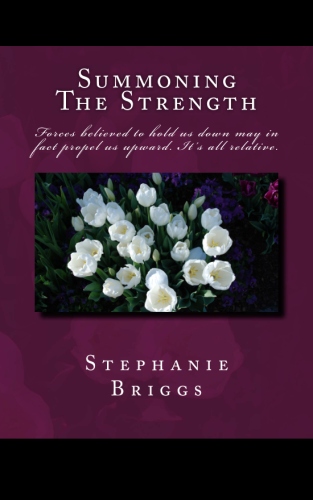
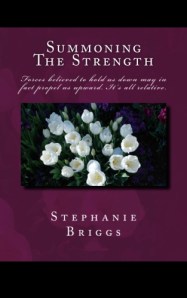
Summoning The Strength is a fictional story about the amazing qualities of ordinary women in the life of the main character, Katherine Doyle.  Katherine grows up in Virginia during the 1950’s and 60’s.  She goes to Syracuse University in 1972.  She is a typical idealistic, naïve, and determined young woman of that era.  Her attitude is much like my own.  It isn’t autobiographical.  However, as the cover says, grandmothers, mothers, sisters, and daughters make the same journey no matter the vehicle.  The story captures the nature of a life well lived and shows how the worst of circumstances can help us discover the best of ourselves.

I was introduced to a circle of intelligent, independent, and hilarious women by a friend.  A discussion of a personal nature turned into a writing exercise, and then for me, an obsession.  I began to experience something that caught me completely by surprise.  I needed therapy.  Not the per hour kind, but the sit still with your emotional baggage until the bus to epiphany comes along, kind.  During this time, my most cherished friend of 23 years was losing a two year battle with cancer.  The pace of the story was affected by this event and the fact that I strive to be concise.  That surprise notwithstanding, I wrote almost without pause day and night.  (No kidding.)  I wanted to share the story and the writing experience with my friend and I read parts of it to her while we spent the last month of her life together laughing and reminiscing.

2. How have your sales been?

Do you hear what I hear?  I think that is the sound of crickets.  Not to worry.  Cha-ching would not only be an unrealistic expectation but also not what I am going for on my first time out of the gate.  It would be dizzying euphoria but isn’t necessary for my happiness. (Short answer: SLOW)

3. You have not sought a traditional publisher.  Why?

I read an article on CNET written by a published author talking about self-publishing.  The article compared the ever shrinking “brick & mortar” publishing houses to the trendy, although less-respected, self-publishing camp.  It extolled the virtues of self-publishing’s quick turn times and low production costs.  It also gave an honest assessment of the quantity over quality marketplace.  There were also some comparisons of the different options available to authors looking for ways to express themselves without the expense of agent or attaché.  I was sold.  I had something to say.  I channeled my inner James Bond and I didn’t look back.

4. You’re relatively new to self-publishing.  How have you liked it so far?

I have been pleased with CreateSpace.  The free tools, reasonably priced upgrades, and prompt responses from member services during the creation process made my first publishing experience a positive one.  I have also connected with like-minded, kindred spirits I never expected to meet.  (I am still smiling.)

5. What sort of marketing techniques have you used to sell your books, and which ones have been most successful?

CreateSpace provides a free bare bones e-store.  I have dressed it up as much as I can with a sophisticated grey background and banner photo I took last spring of some pink tulips.  (You can’t make a silk purse out of a sow’s ear.)  There is a link to my e-store on my blog.  I use the WordPress platform for jumping out there with fresh content to attract readers who like my writing style.  RSS feed of my posts go to my Amazon author page and Summoning The Strength’s Facebook page.  I share my posts on LinkedIn, Google, and StumbleUpon.  (I don’t Tweet.)

I also belong to a few writers’ groups which have yielded one very nice book review and this awesome interview.  Shameless self-promotion and begging seem to be the top tier money makers right now.

I sent copies to buyers for a couple of indie book stores and reached out to the airport book retailer Hudson News.  No takers from the indies yet, but I did receive a snarky email from the buyer at HN saying they don’t waste their premium space on vanity press (only best sellers need apply.)

6. Are there any marketing techniques you intentionally avoided or discontinued, and if so, why?

I avoided spending money on ads or email blasts popular with the scam-spam set.

Once my book sales break say 50, I will probably discontinue approaching strangers in the grocery store and at my favorite neighborhood bar & grill, which can be hit or miss.  This technique can also be embarrassing if a conversation starter in the produce department goes terribly wrong.  Plus it will become cost prohibitive when I have to start driving across town for avocados or a beer since the price of my book is only $9.99.

7. What’s the most important thing you’ve learned about self-publishing that you didn’t know when you started out?

I can do it.  I had never used any professional or social networking sites.  I am not tech savvy.  I leaned into the learning curve and am happy to say, I hung in there.

8. If you could do one thing differently in publishing your books, what would it be?

Hire tech support.  I have a love/no love relationship with technology.  My creativity flourishes when I discover a great tool or resource.  I sometimes become bogged down trying to navigate through the sheer volume of information required to learn how to use them properly.

9. Independent authors face the obvious challenge of marketing their books without the resources of traditional publishers.  What advice do you have for an indie author just starting out?

Reject rejection.  Feedback is just feedback.  Listen to it.  Focus on the positive. That right action alone will yield positive results.  When you make the most of the network you already have in place, your connections will multiply.  Be selective when joining online groups and try not to criticize, condemn, or complain in a public forum. People get enough of that in the news media and they will tune you out double quick. I know because that’s what I do.

10. What projects are you currently working on?

Each time I post to HonieBriggs.com, I learn something.  I’m using those eureka moments to build a bank of ideas for two books.  One is a follow up to Summoning The Strength.  Consistent feedback says people want to know what happens next.  There is more to the story worth a second book.  I also have an idea for a light-hearted look at my own growth and evolution as a person.  The working title is Baptist to Buddhist, My Forty Year Journey.  Because people can sometimes get hung up on religious labels, it is only a working title at this point.  You can see the style of that kind of book in my blog posts.

11. If you could market your brand – not just one particular book, but your overall brand of writing – in one sentence, what would it be?

My writing is word play with a purpose.  (That is my idea of fun.)

12. How can readers learn more about your books?

Visit honiebriggs.com for all things noteworthy.

Shop Honie’s e-store or Amazon for all things written by Stephanie Briggs.  There is more than one author named Stephanie Briggs out there.  (Accept no substitutions.)

Rozsa Gaston

Rozsa Gaston approaches her writing with energy and a love for life.  She has also invested time in a unique marketing technique involving bookmarks and reverse psychology, and she shares some of her ideas here.

1. Tell me briefly about your books – what are they about and what motivated you to write them?

They’re about self-discovery and self-acceptance.  Paris Adieu, my latest book, has two themes: 1) how to be comfortable in your own skin and 2) how to fake it till you make it.  Paris Adieu’s heroine, Ava Fodor, is clueless about both at the start of the book.  By the end, she’s figured out a thing or two – thanks to the insights living in Paris has given her.  Ava studies French women, French food, French attitude – while French men study her.  By the end of Paris Adieu, she’s more or less transformed herself into the woman she wants to be.  And if she hasn’t entirely, at least she’s learned how to fake it till she makes it.  But where to take her act?  Back to New York, of course, where Ava grasps that her newfound sense of self will work for her in a way it never will if she stays in Paris.  After all, she’s not French.  What she is, is fabulous.  I’m still working on both themes.

2. How have your sales been?

Slouching toward fabulous, darling.  Why do you think I’m doing this interview?

3. Have you sought a traditional publisher?

I have and will continue to seek one.  In the meantime, I want to spend my time writing books, and sharing with like-minded people in cyberspace – which means all over the world – instead of sending out query letters that never get a response.  No interaction dulls my interest.

Continue reading

Jason King

Jason King is a fantasy epic writer looking to carve out a unique niche in the genre.  Here he talks about his book, which marketing tools have worked, and which ones haven’t.

1. Tell me briefly about your book – what is it about and what motivated you to write it?

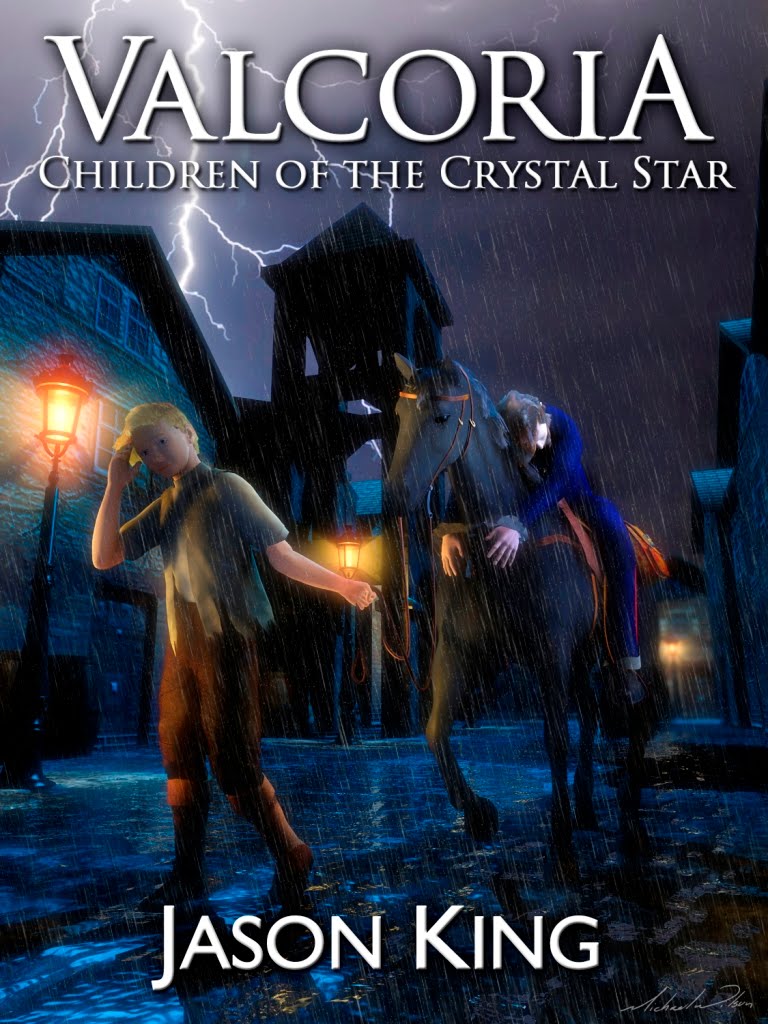
My book is called Valcoria: Children of the Crystal Star, and is a fast-paced, high-action, epic fantasy.  Those familiar with the works of Robert Jordan, Jim Butcher, and Brandon Sanderson will recognize a similar flavor in my writing.  Valcoria has several main characters, and often changes narrative points of view, but the plot centers around a teenage street-thief named Yuiv, and a soldier-swordsman named Sitrell who are thrown together when their city is attacked by an invading army.  Through the efforts of an anonymous sympathizer, they escape execution and are given vital information that they need to deliver to the leaders of their kingdom.

As they undertake an urgent quest to save the kingdom of Amigus, Yuiv and Sitrell soon learn that they are part of something much larger in scope than simple political intrigue or war.  They are players in a conflict between two gods, one striving to protect Valcoria and mankind, and the other seeking to rule and destroy it.

2. How have your sales been?

I’ve sold more e-books than printed copies, which is what I expected and in line with the current industry trends.  It hasn’t taken off the way I had hoped, but the blame for that is on my lack of marketing, something that I am trying to remedy.

3. You have not sought a traditional publisher.  Why?

Originally, I was pitching my manuscript to agents and publishers, but wasn’t having much luck.  A friend suggested I try Amazon KDP, and so I published Valcoria myself as something of an experiment.

Continue reading

Barbara Fleming

Barbara Fleming writes from personal experience with her book, The Backwards Buddhist: My Introduction to Dzogchen.  Here she talks about a variety of marketing techniques and why she would choose to only self-publish.

1. Tell me briefly about your book – what is it about and what motivated you to write it?

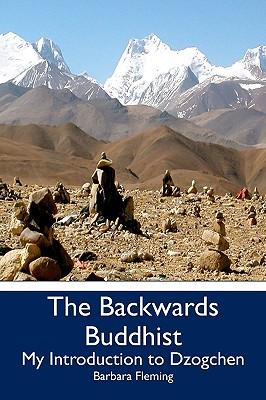
The beginning of the writing process was a challenge to write a book in a month.  The story, of necessity, was autobiographical so that it required no research.  Having just completed part one of recreating myself from the ground up by divesting myself of every spiritual thought or preconception I ever had from birth to age 50, it was a logical choice of subject matter.  The path I chose was so unlikely for me, it seemed a great example of the improbable becoming true.  My premise was I could choose to live in a world created by some perception of how things should be, I could just show up every day ready to embrace whatever arose, or I could experiment with any one of an infinite variety of combinations of the two.  Tibetan Buddhism is not the first place most westerners look to find their personal path, but it was mine, so that is what the journey is all about.  Finding a path with potential but no map and no fixed destination was my recipe for self-discovery.  Setting off on such a quest just because I could, and recording the journey to show the potential, complete with embarrassing pitfalls as well as triumphs, should anyone else want to do so, is the major point of the book.

2. How have your sales been?

Sales have been surprising.  My expectations were zero, so selling a few hundred was quite fine and I continue to sell.  The most surprising sales were triggered by the inclusion of my title on a college neuro-science course reading list, the subject being the Brain and Meditation, quite a hot topic these days.

3. You have not sought a traditional publisher.  Why?

I did not seek a traditional publisher because no one owes me any personal favors.

Continue reading

Paul Xavier Jones

Paul Jones is a sci-fi writer who draws influence from his own family and lifetime of reading.  In this interview he discusses why he’s avoided traditional publishing and which marketing techniques have not worked for him.

1. Tell me briefly about your books – what are they about and what motivated you to write them?

My Epic Fantasy “Ameca J” series is a trilogy that takes place in the fictional world of “Mythrania” and is based on my two daughters.  The inspiration comes from a lifetime of reading fantasy and science fiction, and a genuine desire to promote “family” values for my two girls who were always fighting.  So the inspiration was, what if it was only the two of them, trapped in an unknown, dangerous world populated by strange and savage creatures?  Would the eldest girl step up to the responsibility of keeping the younger safe?

My first “Blake Trubble” novel is a sci-fi/thriller, the idea for which came to me while I was researching the first Ameca J novel, and in particular the Large Hadron Collider experiment situated on the borders of France/Switzerland.  As a big fan of the Alien, Predator and John Carpenter’s “Thing” movies, I wanted to create a similar paranoia but this time in a sealed facility 15 miles in diameter and located underground.  Throw in two deadly enemies and 400 hostages and an unknown menace, and you have some great ingredients for a classic sci-fi/thriller.  Blake Trubble is the name of the main character, a major in the SAS, and allows me to use quite a few cheesy lines, such as “You want trouble, you’ll get it.  Major Trubble.”

2. How have your sales been?

Sales are slow.  But that is because I’ve self-published and self-promoted, which takes more time to do than actually writing the books themselves.

3. Have you sought a traditional publisher?  Why or why not?

I have not sought a traditional publisher.  There are several reasons why not, the first of which is the inspirational stories of Amanda Hocking and John Locke, both impressive success stories of people who have self-published and self-promoted.  Another reason is I have no patience for writing submissions and synopses; if I’ve just written a hundred thousand word novel, I am not going to try and condense it into two pages for some lazy publisher or agent.  Finally, the true judge of a good book should not be a publisher or agent, but rather the public.

Continue reading

Helen Carey

Helen Carey is both a traditionally published author as well as an indie.  She offers her views on both camps and what marketing techniques, including a YouTube video, she’s used in her own efforts.

1. Tell me briefly about your books – what are they about and what motivated you to write them?

I am best known for my London-based wartime novels, Lavender Road, Some Sunny Day and On a Wing and a Prayer which were all commissioned by Orion.  My neighbor in London had lived through the Second World War and her stories of people showing courage in adversity gave me the idea for a series of novels following the lives of a number of people living on one particular street.  In On a Wing and a Prayer one of the characters, Helen de Burrel, joins the SOE and is sent into Nazi occupied France.  A lot of readers told me that they had found the final scenes of that book very exciting as Helen evades the Germans to blow up the ships in Toulon Harbor.  I enjoyed writing those scenes too and it gave me the idea of writing a contemporary thriller or crime novel.

My latest novel, Slick Deals, is a pacy, exciting crime adventure set in Monaco, London and West Wales, where I now live.  The main characters are a chic London city-girl oil trader, Ella Crossley, and a rather scruffy American environmentalist, Nick Jardine.

2. How have your sales been?

All the books are selling well.  I am pleased with the progress so far.

3. You’re relatively new to self-publishing.  How have you liked it so far?

I have enjoyed having control over the content and design of the books.  Doing it yourself takes away all the frustrations about publishers failing to do things they had promised to do.  On the other hand there is the knowledge that if mistakes slip through they are your own fault!

Continue reading

Andromeda Edison

Andromeda Edison helps promote independent authors, and draws on her deep experience with internet marketing.  Here she discusses her work and what she’s learned about e-books and self-publishing.

1. You’ve been in internet marketing since 1996.  Describe the sort of work you’ve done.

I started in search engine optimization in 1996 before there was a name for it.  I expanded and changed with the industry, so that I got involved in email marketing, blogs, social media marketing and others as these things came on the field.  In 2011 I expanded to e-books creation and marketing where all my Internet marketing skills can be utilized.

2. How has internet marketing changed since you first got involved with it?

Unfortunately this is a loaded question; a lot has changed since I first started, this could be (and is) a whole book.  When I first started there were very few avenues you could utilize: search engines, forums and email was it.  Now there are a lot of different ways you can go and you have to take a look at each one to see which ones will be best for reaching the public.

The fun part is that the changes haven’t stopped, just like technology evolves (check out the latest iPhone compared to the one before).

3. Your experience in this field is quite extensive.  What advice do you have for indie writers looking to use the web in their marketing efforts?

The Internet is becoming a world of interaction, you can’t just post information up and expect people to come to it.  You have to drive people to you and the way you drive people to you is going where they are and enticing them with some of what they are looking for.  Authors are mini-celebrities (and they get bigger based on how much they sell) and people love to be connected to mini-celebrities in a personal way so you can use this for all it is worth.

Continue reading

Nancy Ellen Dodd

Editor and award-winning writer Nancy Ellen Dodd, M.P.W., M.F.A., teaches at Pepperdine University and has had extensive experience working with authors, including indies.  In this interview she touches on her work, what she’s learned during her career, and how to write your best work possible.

1. Describe your educational and writing backgrounds.

For more than 25 years I’ve invested thousands of hours of studying writing, including two graduate degrees: a master’s in Professional Writing (MPW, which is a multi-discipline approach to writing) from the University of Southern California and an MFA in playwriting at USC’s School of Theatre.  I have received numerous awards for my writing and some of my stories have been read on public radio.  I’ve also studied writing with several successful, award-winning writers.

My book, The Writer’s Compass: From Story Map to Finished Draft in 7 Stages, covers the full creative writing process. I’ve also published more than 130 articles and been editor of two print and two online publications.  Presently I’m academic editor of the Graziadio Business Review, a business journal for the Graziadio School at Pepperdine.  Currently, I teach screenwriting at Pepperdine University to undergraduate and graduate students.

2. Tell me briefly about The Writer’s Compass.

The Writer’s Compass is what I’ve learned after thousands of hours of studying writing and two graduate degrees.  Through this process I developed a story map based on the 3-Act structure chart and Aristotle’s and Freytag’s principles of dramatic writing to use as a tool for understanding your story.  For years I have been collecting and developing questions that writers should ask about their stories and I evolved these into a 7 Stage process for writing more efficiently with fewer drafts.  I’ve been using this method, teaching it in workshops, and using part of it to teach my screenwriting students for years.  I finally turned it into a book.

Continue reading