 Julie Hawkins has found creative freedom as an indie, and focuses her writing on Civil War fiction. She talks about the techniques she used to tap into a specific market.
1. Pretend for a moment I’m a reader looking for my next book. Pitch me your book in five to ten sentences.
In the spring of 1861, a country once united is fractured by war. In north Alabama, Hiram Summers, a farmer and father of three, enlists to protect his inherited property. His son, David, also desires to go, but is instead obligated to stay behind to care for the farm. Hiram travels to Virginia with the Fourth Alabama Infantry Regiment, where he is quickly and inevitably thrust into combat. In the meantime, David searches for adventure at home by traipsing to Huntsville with his best friend, Jake Kimball, to investigate rumors of invading Yankees. Their escapade turns into harsh reality when they discover the true meaning of war, and after two years of service, Hiram sees enough tragedy to last a lifetime. A Beautiful Glittering Lie addresses the naivety of a young country torn by irreparable conflict, a father who feels he must defend his home, and a young man who longs for adventure, regardless of the perilous cost.
2. What motivated you to become an indie writer?
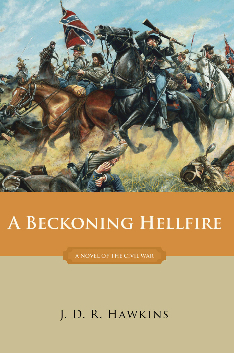
I am just starting out in the book publishing industry, but I would eventually like to be published by a traditional publisher. Indie publishing is a good way to springboard my work into that industry. Since I published my first book, A Beckoning Hellfire, independent publishing has changed dramatically, so that now authors can have bestsellers without being picked up by traditional publishers.
3. You have not been traditionally published. Why?
Working independently gives me the freedom to express my views without conforming to the traditional market. It has more flexibility and opportunity than ever before. Traditional publishers are looking for bestselling authors with an accomplished track record. What I have found by attending conventions is that there are a lot of independent writers who are equally talented. Being published independently doesn’t reflect the quality of writers who are out there.
4. How have you liked self-publishing so far?
My experience with self-publishing so far has been very good. It has given me a vehicle in which to publish a story that I feel passionately about. It has also enabled me to establish a following of readers who have an ongoing interest and relationship in the Civil War market.
 Kris Wampler
You must be logged in to post a comment.