Nicholas LeVack

Nicholas LeVack has found success selling his short stories on the Kindle Direct Publishing platform.  On the verge now of releasing his first book, Nicholas discusses how he used social networks – both online and in real life – to broaden his market and move sales.

1. Tell me briefly about your books – what are they about and what motivated you to write them?

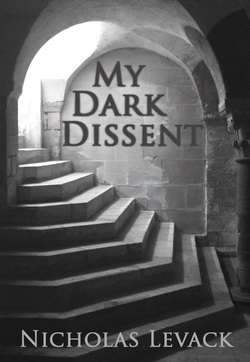
My currently released titles are My Self-Loathing Jailer, Downpour and My Dark Dissent, all of which are short stories that heavily use metaphors or conceits.  My Self-Loathing Jailer and My Dark Dissent are symbolic of personal struggles I dealt with in my youth and, in some capacity, still fight today.  They’re about how crippling insecurities can be in regards to their ability to isolate you from the rest of the world, even if just socially.  I don’t want to sound arrogant, but I think they’re good messages for those who suffer with depression or have experienced bullying, only they’re presented in a way an average reader might find a little less accessible, given the cryptic nature of the symbols and messages.  Downpour, though not a tragedy I’ve experienced personally, deals with an often dreaded situation and a state of mind – the absence of control in one’s life – I believe most of us have experienced at least once.

2. How have your sales been?

I honestly hadn’t expected my short stories to be a viable contender on the market at all.  However, I’ve at least made enough for my efforts to be justified.  And compared to some of the authors I’ve spoken to who’ve been e-publishing for longer than I have, I’d say I am doing pretty well for myself.  I believe the most important thing I can do to improve my sales is just keep writing, because readers will be more willing to spend their hard-earned cash on someone who looks established due to a lasting presence on the market. Fortunately, writing is what I do – I’m not just publishing my work to make a quick buck, it’s because writing is the only thing I’ve ever been able to consider as a career.  Even if I’ll never make ends meet with writing alone, I’ll strive for it as long as I am able, and I’ll keep putting out stories for people to either pass up or – and I’ll always be eternally grateful for this – actually purchase.
Continue reading

H.P. Stephenson/Kathryn Tedrick

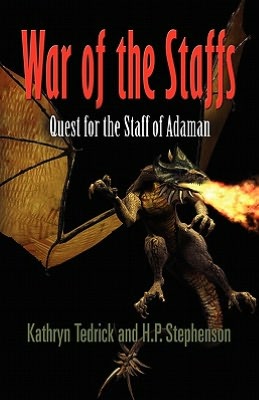
H.P. Stephenson and Kathryn Tedrick are the authors of War of the Staffs: Quest for the Staff of Adaman.  In this interview, they discuss why they use blogging and social media – and why they advise against using a marketing firm.

1. Tell me briefly about your book – what is it about and what motivated you to write it?

A powerful vampire wizard named Taza is brought through the void by Adois, a vengeful goddess who lends him her staff so that he can take over the planet, Muira, and turn it from good to evil.  He convinces a race of dark elves to take on the cloak of vampirism, but his careful planning is jeopardized when Prince Tarquin is born to fulfill a prophecy.  Tarquin, however, cannot succeed alone, and when Morganna, an Illanni noble woman, threatens Taza’s plans, she prevents her cousin from destroying the prophecy.

Tarquin is sent to the dwarvan militia to learn combat and survival skills by joining an elite group of soldiers known as the Borderers. He is championed by the wizard, Celedant, who begins his search for the Staff of Adaman – the only object capable of defeating the Staff of Adois.

Book one of the trilogy, The Quest for the Staff of Adaman, begins with the search for the first of two pieces of the ancient staff as Taza’s assassins hunt the prince to thwart the prophecy.  Tarquin, however, is not the only target.  Celedant must confront not only assassins, but powerful and dangerous creatures that Taza brings through the void to destroy him and the growing resistance among the dwarves, wood elves, and high elves.  But first, Celedant must take the final test to become a Master Wizard.  If he passes, he will be able to battle the Staff of Adois and the monster that wields it.  If he fails, not only will the world be overrun by evil, but Celedant will be lost in the Dragon’s Tear for all eternity.

[We] both love epic fantasy and have always wanted to develop our own series.

2. You’ve not worked with a traditional publisher.  Why?

We tried to go the traditional route, but although several seemed interested, they didn’t want to take a risk, or else did not handle epic fantasy.  So with so many people self-publishing e-books, etc., we decided to give it a try.

Continue reading

Kathryn Brimblecombe-Fox

Australian writer Kathryn Brimblecombe-Fox infuses her writing with her art, and in so doing expresses these two facets of her creativity.  In this interview she discusses the marketing efforts she’s used and why self-promotion comes naturally to her.

1. Tell me briefly about your book – what is it about and what motivated you to write it?

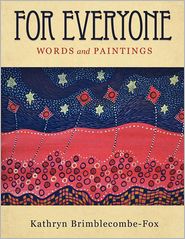
My book For Everyone: Words and Paintings has thirty paintings, each accompanied by some short poetic prose, which is neither descriptive nor didactic.  Rather, the words stimulate the reader’s own journey by calling to their inner child or essence.  This small voice echoes from childhood leading to conversations either with oneself or others.  For Everyone is really about conversation and the compassionate spaces it reveals as we get to know ourselves and others.

The paintings inside For Everyone were created fourteen years ago and were responses to observations of my then very young children.  However, the intervening years have revealed that the paintings are not simply about my children.  They are visual representations of the small voice, our inner child or essence, which influences our lives from childhood to adulthood, and possibly beyond.

The text is printed in a large font size.  I deliberately did this so that people do not necessarily have to wear their glasses to read For Everyone!  It is the type of book which appeals to all ages and both sexes.

I was motivated to write For Everyone seven years ago, when friends suggested the series of paintings would make a good book; but my submission to Hay House was not accepted, although they sent an encouraging letter.  I filed the manuscript and put the paintings in a storage satchel.  The paintings have never been exhibited, but will be on show at my book launch in February 2012.  In January 2011 I was contacted by Balboa Press, the self-publishing arm of Hay House.  They said Hay House had given them my details.  They asked if I had published the manuscript, and if not would I be interested in self-publishing with Balboa.

2. How have your sales been?

As it is still early days, it is hard to tell how sales are going.  However, so far three bookstores in Brisbane have taken books.  These are Coaldrakes, plus the two bookstores at the Queensland Art Gallery and Gallery of Modern Art (GOMA).  I am aware that there have been sales via Balboa Press and Amazon.  I have also personally sold a number of books.  I am expecting good sales at my book launch in February.  For Everyone is available online from many sites including Balboa Press, Amazon, and Barnes & Noble.

Continue reading

Aditi Chopra

Aditi Chopra is a consultant who approaches her writing with the goal of helping others.  Here she discusses her books and why self-publishing, rather than the traditional model, gives her pride in her work.

1. Tell me briefly about your books – what are they about and what motivated you to write them?

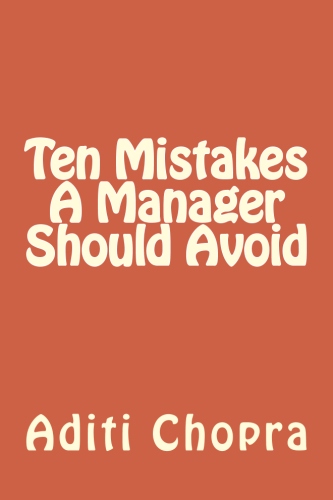
I have written two business books from my personal experience.  The business process management book titled How to Succeed as a Process Professional covers the challenges that process professionals face and provides practical tips on how to overcome them.  I am basically teaching the tricks that worked for me in the corporate environment.  My leadership book titled Ten Mistakes A Manager
Should Avoid
is written from my experience as a first line manager of software engineering and software operations teams.  With this book, my hope is to enable all managers to succeed in their leadership career.

I was motivated to write both of these books so I could help others succeed by sharing my knowledge.  I am of the belief that if you know it, you ought to share it with others.

2. How have your sales been?

My sales have been picking up.  However like I said, I am not motivated by sales but by helping others succeed.

3. Have you been published by a traditional publisher?  Why or why not?

When I thought of writing books, I surveyed a few different authors and they guided me towards the self-publishing model for various reasons.  I did not consider the traditional publishing model.  I am also the kind of person who likes to get their hands dirty and who feels more pride in my work that way.

Continue reading

John Kenworthy

John Kenworthy is the quintessential eclectic writer, using his various life experiences to craft his writing.  In this interview, John discusses how he uses social media and how he directs much of his marketing to independent bookstores.

1. Tell me briefly about your books – what are they about and what motivated you to write them?

My first book, The Hand About the Mouse: An Intimate Biography of Ub Iwerks, was published by Disney in 2001.  Co-written with Ub’s granddaughter, Leslie, we tell the compelling story of one of the most amazing minds in entertainment history.  Ub is the forgotten man.  For me personally, I have always been drawn to those geniuses who work seemingly without ego behind the scenes to lift up technology and art – and Ub is an incredible example of that.  He created Mickey Mouse, added color, sound, multidimensionality, and xerography to cartoons.  He created technology to combine live action and animation and perfected techniques that he used to great effect with Alfred Hitchcock’s “the Birds”.

My second book is a breezy little industrial book entitled, Bungee Jumping & Cocoons.  It follows two trends in the consumer world: that of extremes (bungee jumping) wherein we treat life like one grand adventure; and that of isolation (cocoons) wherein we’d just as well stay at home.  The prime example I use for that is Barnes & Noble versus bn.com.  Both sell books.  One sells them via experiences and the other sells them via comfort.  The second half of the book applies these same themes to industry.

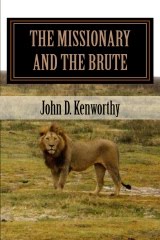
My current book, The Missionary and the Brute, is an adult literary novel that spans genres of horror and suspense.  It follows the case of a serial killer in Tanzania, East Africa, through the eyes of an American missionary accused of the crime.  The idea for the book came to me on one of my many journeys to Tanzania as the founder/executive director of Brick by Brick for Tanzania!, Inc. (www.brickbybrickfortanzania.org), a tax-exempt non-profit that builds preschools in Africa.  Having seen equal parts tragedy and beauty during my time in country, I fashioned a fast-paced, twist-around-every-corner mystery that draws the reader in as we head towards the stunning conclusion.

2. You’ve written in a variety of styles and media.  Tell me about that.

I’m a pretty diverse guy.  I feel like I live many lives in one and my writing styles reflect those ever-changing aspects.  I played harmonica in a biker band for years, so it made sense that I fictionalized those experiences with my short stories in Easyriders Magazine.  Having been a motion picture projectionist, I delved into cartoons and wrote my biography, an animation blog and a couple of screenplays for A Film A/S (a Danish animation studio).  My journeys to Africa obviously infused “The Missionary and the Brute” with a realistic setting.  All of my experiences have led me piece by piece to more experiences and more writing.  The styles reflect that diversity.

Continue reading

Andrew G.

Andrew G. is a science buff who turned his love of astrophysics into a sci-fi novel. In this interview he talks about the task of doing research for one’s writing and explains why he made a book trailer to promote his novel.

1. Tell me briefly about your book – what is it about and what motivated you to write it?

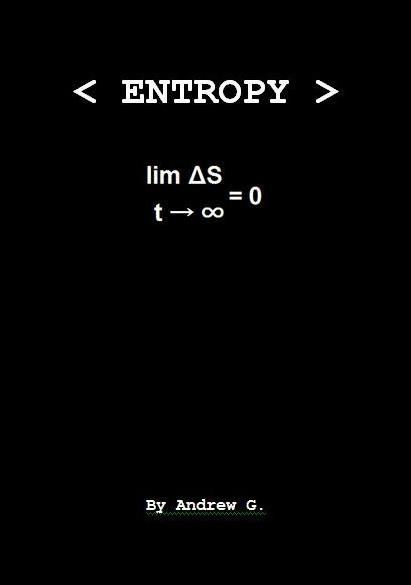
My novel, Entropy, is inspired by my love of science, particularly astrophysics.  I read Michio Kaku’s (a co-founder of string theory) book “Hyperspace” when I was a teenager and it changed my life (as well as completely kicked open the door to my narrow perception of what reality is).  After that I was hooked, I bought every other book Mr. Kaku has written and a lot more from other physicists such as Kip S. Thorne, who has done extensive research on wormholes and practical time travel.  While the mathematics are far beyond me, having only taken three calculus courses and a beginner’s differential equations course in college, I am content with marveling at the concepts that are produced year after year in scientific journals and so forth.  This novel is a culmination of my enthusiastic love of these related sciences as well as my fascination with the unknown.  I’ve had the concept in mind since I was young, slowly building a story line in my head for years.  However, it was just recently that I started writing it down into a novel.

2. How have your sales been?

Since I started (which has only been a week), it’s been about a book a day.

3. What has been your experience with traditional publishing?

Hated it.  I tried really hard to have a children’s book published, but no one will even talk to you if you haven’t published before or aren’t represented.  It’s a system that is biased and viciously subjective in my opinion.  I queried 300+ agents and publishers and no one was interested in giving me the time of day…not one.

4. How have you liked self-publishing so far?

Loved it.  It’s easy and more profitable.  I feel that I have so much freedom with my work and I think that even if I do get an offer from a publisher, I would still stick with this.  It’s a little more work, what with editing and marketing myself, but so worth it.

Continue reading

Brian T. Shirley

Brian T. Shirley has a unique approach to moving his books: integrating them into his comedy routine and selling them after his shows.  The author of Make Love Not Warts and Four Score and Seven Beers Ago discusses why he skipped traditional publishing and how he learned to do his own promotion work.

1. Tell me briefly about your books – what are they about and what motivated you to write them?

Both my books are comedy one-liners.  I’ve taken old sayings and twisted them around to make some new ones.  I also have added some sayings of my own and thrown in some insults for good measure.  The second book is a bit different in that I’ve taken some popular song titles and made comedic sentences out of them.  These comedic sentences are sprinkled throughout the book.  I’d like to think the readers could make up a game of trying to name the music artists in the sentences.  Some would be easy, others may take a while.  There is also a funny poem at the end of the second book.

I was motivated to write these books when I was going over some old material I had that I was not using in my show.  I had all these sayings and such laying around that I had written over the years that I did not know what to do with, then the idea of a book came to mind.  Something someone could put in the bathroom or on the coffee table for a good laugh whenever they needed it.  I added more lines when I started writing the first one and by the end of it, I decided to make a series of these books.  Each one would be a little different, just to add some variety.

2. How have your sales been?

So far I have sold the most books after my performances.  I’ve actually had more sales from the books than anything else (T-shirts, DVD’s) I’ve ever sold.  Online sales are doing alright, getting the word out as a self-published author has been the biggest challenge.  It takes a lot of money to do promotions so I’m doing the bulk of it myself online. Thank God for people like you.

Continue reading

Robert Brabham

I met Robert Brabham at a recent Charlotte Writers’ Club meeting and knew he’d make a good addition to the blog.  Robert is a short story writer whose genre is uniquely his own, and he shares his thoughts on writing and networking here. 

1. Tell me briefly about your book – what is it about and what motivated you to write it?

I was determined to have a book “out there” this year and culled together a mixed sampling of my short stories in Does This Knife In My Back Make My Butt Look Big?  Tales of Madness, Eisegesis, and Other Unpardonables.  It is available on Amazon and Lulu.com.  The stories fall under the appellation of speculative fiction, but run the gamut of literary, sci-fi, humorous, experimental, and a couple of out and out horror yarns.  I like to call my work “intense fiction.”  Faulkner said the job of the writer is to express the conflict in the human heart and I suppose that’s what I’m after.  When people ask me where I get my ideas, my response is: I don’t get ideas; they get me.

2. How have your sales been?

Sales have been more than modest without a substantial advertising campaign.

3. How does self-publishing compare with traditional publishing?

I have had success with some short stories with Down in the Dirt magazine, which publishes on demand with Lulu.com and is now available on Amazon.  The short stories also appear on their website.  Down in the Dirt is more of an independent soul and not a traditional publisher.  I self-published my collection of stories with Lulu.com and found their advertising offers prohibitive in cost and have been relying on social media thus far.

Continue reading

Doug Simpson

Doug Simpson published his first novel, Soul Awakening, in October.  Though a new author, Doug is not new to writing: he has had numerous articles published throughout the world.  He’s already learning self-publishing and wanted to share his experience.

1. Tell me briefly about your book – what is it about and what motivated you to write it?

Soul Awakening is a spiritual mystery that delves into reincarnation, past lifetimes, and the attraction of strangers in this lifetime to each other as a result of having shared previous lifetimes together.

I spent a number of years researching the life and reincarnation readings of the legendary American mystic, Edgar Cayce.  Some 2500 of Edgar’s over 15,000 readings, obtained while he was in a deep, self-induced, trance-like state, are reincarnation readings.  These readings reveal details of a person’s past lives, but not all of their past lives.  Only incarnations which were relevant to the reasons why an individual’s soul chose the individual’s body as its residence in this lifetime, were revealed.  To put that in different terms – a soul selects its next residence to achieve progress in its development so it can return to its original God-like state with no further need to reincarnate.  The knowledge which I obtained while researching the Edgar Cayce readings nurtured the seed that became Soul Awakening.

2. How have your sales been?

I have no idea.  I decided that I did not want the hassle of personal selling, so I set it up for all sales to go through brick-and-mortar and internet bookstores.  It is too soon to get much feedback.

3. What has been your experience with traditional publishing?

After a series of form letters like “We are not currently accepting …” from traditional publishers and agents, I implemented Plan B.

Continue reading

Jonathan Lister and Kevin Fuhrman

Authors Jonathan Lister and Kevin Fuhrman are set to release a self-published urban fantasy, Welcome to Demos, in January.  I recently corresponded with Jonathan to learn more about the book and how he and Kevin are building buzz around it.

1. Tell me briefly about your book – what is it about and what motivated you to write it?

“Welcome to Demos” is in that urban fantasy vein.  It’s a story about family interactions in a supernatural world where werewolves have lived openly with humans since before recorded history. Basically, we’re looking at the real-life implications of supernatural beings without the “coming out party.”  Everybody’s here, everyone knows it, to the next scene we go.

This story came about from what we saw as a lack of strong male leads in the market.  Our characters aren’t bemoaning their existences, they’re living them and struggling to achieve goals – with some police corruption, gun shot wounds, mysticism and coffee thrown in.

2. How have your sales been?

We recently announced our release date of January 1, 2012.  Kevin’s joked that the interest we’ve generated so far is kind of shocking to him.  In his words: “The Urban Fantasy genre is full of talented and prolific authors and the idea of something we’ve created standing out enough to get this kind of response is a shock to my normally pessimistic nature.”

3. Describe your experience with traditional publishers and how it compares to self-publishing.

From my perspective publishing with a traditional house and then going independent, it’s completely different – 100 percent control is scary, exciting, tiresome and really rewarding all at the same time.  We shopped “Welcome to Demos” to agents at first and we’d get requests for pages only to be turned away without much feedback.  If anything, this teaches us an agent isn’t a mandatory part of the process.

Continue reading