 Christiane Joy Allison has built her author platform by becoming active in the writing community. Here, she explains a few of the pros and cons of self-publishing.
1. Tell me briefly about your latest book – what is it about and what motivated you to write it?
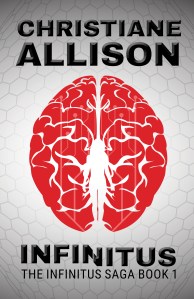
The Infinitus Saga is a cyberpunk adventure series following the Mallorey family’s struggle to survive in a world run by the Global Fellowship and their Global Reform Interface and Database (GRID) computer system which runs on the “wetware” of the human brain. They’ve managed to hide in the shadows of a world where the disabled disappear, but now they can’t anymore. The series is jam-packed with futuristic technology, tech-savvy rebels, and genetic animal-human hybrids known as chimeras. In the latest book, Infinitus, the community needs conformity. The squids are out to dismantle it. Now both want what’s in her head. Infinitus is the story of Gina Mallorey, a young freedom-loving tech dealer living in the Dregs on her own terms, hiding her disability from the Community. When an explosion forces her into the GRID, powerful forces make her a target. The Community operative sent after her hides a genetic secret of his own, but only time will tell if he’ll choose to be friend or foe.
2. How have your sales been?
The sales of all of my books were dramatically impacted by the COVID-19 situation. Numerous in-person sales events were cancelled, reducing expected sales estimates on all titles. Funding sources that supported the publication of many of the works means that royalties result in straight profit from the beginning, but sales have been poor this year across the board.
3. You’ve chosen self-publishing. How have you liked it so far? Talk about some of the positives and negatives you’ve encountered.
I like many of the aspects of self-publishing. I enjoy the control the process affords me over the final product. I enjoy being able to bring products to market faster than you would with a traditional publisher. I also enjoy just being involved in all the decisions that bring the book into the world.
Funding has been another major bonus of self-publishing. My first two books were funded entirely through KickStarter funds and grants that carried over to also support some of the costs of the next two books. Because of this, royalties result in profit much sooner, and the royalties I receive per book are much higher than they would be from a traditional publisher. However, not every self-publisher would have this experience. It takes quite a bit of leg work and a little luck to gather those kinds of funds.
On the negative side, the burden of marketing is entirely on you as the self-publisher. Wearing so many hats often means tasks have to be set aside in order to make progress in other areas. For example, when producing more content or a new product, I will not have the same time or energy to pour into marketing.
 Michael Stephen Daigle has had experience with both traditional and self-publishing. He suggests a variety of in-person marketing techniques and explains which ones work best.
 Kris Wampler
You must be logged in to post a comment.