John J. Hohn

Author John J. Hohn has experience in marketing and sales that he’s been able to use, not only to drive plot, but to drive sales.  In this wide-ranging interview, John explains that background, as well as why he hired a publicist and why taking shortcuts can hurt indie writers.

1. Tell me briefly about your books – what are they about and what motivated you to write them?

I have published two books.  The first is a poetry chapbook entitled As I Was Passing By that I self-published in 2001.  I have been writing poetry since I was a boy and the time had come to publish a collection for my friends and family.

My novel, Deadly Portfolio: A Killing in Hedge Funds, was first published in the fall of 2010.  It was well-received by reviewers with established credentials on the Internet.  I began the book after retiring from my position as a financial advisor with Merrill Lynch in Winston-Salem, NC.  The book is the third novel for me.  The others are still in my file cabinet.  They represent my apprenticeship.

Deadly Portfolio flows out of my experience as a financial advisor, a position in which I had a unique perspective on the lives of my clients.  I came to know how they made decisions, how well they got along with their spouses, parents, and children, their trials at work or elsewhere in their lives.  I saw altruism and greed, generosity and miserliness.

The story is about four families and the tragedy that involves them all after one man, a financial advisor, bends the rules and makes an unauthorized trade in a client’s account.  His transgression sets off a string of events that ultimately claims the lives of three of the neighbors before Detective James Raker tracks down the killer and makes an arrest.

2. How have your sales been?

Sales have been steady.  I did not know what to expect at first.  I have sold approximately 500 copies, not including the Kindle version on Amazon.

3. What has been your experience with traditional publishing?

I tried to get an agent to represent my book for almost a year with no success.  I also sent queries to the few publishers who accept direct submissions.  I received a number of encouraging responses but no takers.
Continue reading

AJ Borowsky

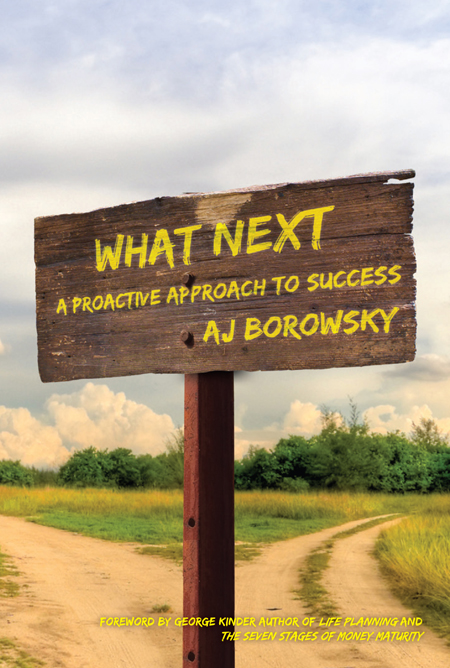
Writer AJ Borowsky likes to think of his first book as a practice run.  Since publishing his second book, What Next: A Proactive Approach to Success, he’s learned more about the work that indies must devote to moving their books.  AJ shares that information here.

1. Tell me briefly about your books – what are they about and what motivated you to write them?

I’ve written two books but the first was just a rehearsal.  I wrote that one, a personal finance book, under a pseudonym and I’m glad I did.  That book really had some good ideas but the execution wasn’t there.  I may re-release it in the future.  I wrote it because I was tired of reading personal finance books that purported to know the “secret” to building wealth or getting rich when the reality is there is no secret.

My latest book, What Next: A Proactive Approach to Success, was written for two reasons.  The first was that I was shocked to get a royalty check for the first book.  It was for only six dollars but if someone (or two or three people) bought it, then maybe I could do better with a well-written, researched, and marketed book.  The second reason I wrote What Next was because I realized that the most successful people I know shared several traits: they were curious, adventurous, and were willing to take risk.

Those traits can also be used to describe independent authors.  We are curious or creative enough to write, adventurous enough to share our writing, and willing to take the risk, and expense, of publishing our work.

2. How have your sales been?

It’s very early in the process but let’s say I’m thankful for friends and family.  What’s most important to me is the feedback I’ve gotten.  It’s one thing for friends and family to buy the book but quite another when they read it and buy several more as gifts or recommend it to their friends.  I’ve been encouraged by that.  Unlike fiction, the number of people who are looking to read a non-fiction book are a bit limited.  Although I don’t like the label self-help that really is the genre of my book and that market is even more limited.  But I feel I approach the material a bit differently.

Continue reading

Jennifer Oberth

Jennifer Oberth writes mystery with a touch of humor.  Her love of writing as an art is evident both in her novels and her approach to her craft.  In this interview she discusses her books and explains what new indie authors should do from day one.

1. Tell me briefly about your book – what is it about and what motivated you to write it?

Married To Murder is a short story mystery set on the wedding day of Ella Westin.

Ella doesn’t recall adding ‘solve a murder’ to her bridal to-do list but when she stumbles over the body of her matron of honor, she has no choice; her groom is the only suspect.  Throw in a deaf hairdresser, a ruined wedding cake and a not so retired pirate and Ella wants to throttle everyone in sight.  Can she catch the killer before the wedding is called off?  Or will she be Married To Murder?

I wrote this for a short story contest.  I’d already done the background work – Ella & Joe are the grandparents of the Westins in my upcoming novel series, The Masked Rider.  They’re a lot of fun to write.

2. How have your sales been?

Pretty steady and growing with pockets of nothing.  I’m focusing on the writing aspect and getting more books published. (I have several in the editing process right now.)  It’s interesting, I view my writing as a business but then I get disheartened by various factors
such as sales or reviews or forum comments.  If I look at it as a hobby, it’s a wonderful addition to my life and setbacks and cost of professional editing are in line with the leisurely pursuit of publishing books.  But it’s not a hobby, it’s how I want to eventually make my living.

Continue reading

Robert Lamb

Robert Lamb has taught writing at the University of South Carolina since 1991, when his first novel was published.  He is now an adjunct professor in the university’s journalism school.  Not only is he an experienced writer, but he’s a publisher who years ago recognized self-publishing as the wave of the future.

1. Tell me briefly about your books – what are they about and what motivated you to write them?

My first novel, Striking Out, is a coming-of-age story set in the South of the 1950s.  It was nominated for the PEN/Hemingway Award and, though published in 1991, is still in print.  My second, Atlanta Blues, is about the search for a missing coed by a newspaper reporter and two cops.  The search leads through the underbelly of urban Atlanta to murder and heartbreak.  The book was a Southern Critics Circle Selection and cited in one newspaper’s year-end roundup as “one of the best novels of 2004 by a Southern writer – and maybe the best.”

My third, A Majority of One, came out this past September and is about a high school English teacher who gets into deep trouble when she resists an effort by local preachers to ban some classic American novels from the classroom, foremost among them The Adventures of Huckleberry Finn.  Six of One, Half Dozen of Another (Stories & Poems), also only recently published, represents my writing life (thus far), with stories and poems virtually from yesteryear and yesterday, with an afterword on their origins.

I am motivated in everything I write by the glimmer somewhere in my mind of a good story that wants to be told.  I will never live long enough to write all that petition for a hearing – which is strange because until I was about 40 I had not a single idea for a good novel, and no idea how to write it if I did.  I’ve often said that I knew how to write long before I knew how to write a novel.  Novel-writing does require some know-how, which means it is a craft.  Get good enough at the craft and you might elevate what you write to the rarefied level of art.

Continue reading

Melissa Bowersock

Melissa Bowersock has written a variety of books across different genres.  As someone who has both self-published and been traditionally published, she has an interesting approach to marketing that can help all writers.

1. Tell me briefly about your books – what are they about and what motivated you to write them?

I have 4 romance novels, 2 that are Westerns (The Rare Breed, Superstition Gold) and 2 that are contemporary (Remember Me, Lightning Strikes).  I like to think that my romances are more for thinking readers rather than the formulaic sexual tension novels.  I believe my characters grow a lot during the course of finding love.  The Blue Crystal is a fantasy sword-and-sorcery novel, much like Lord of the Rings.  I have 2 action-adventure novels.  Queen’s Gold is based on a past-life regression where a man tries to find ancient Aztec gold he hid in a previous incarnation.  The Appaloosa Connection is a western in which a horse rancher and a sullen teenager go after horse thieves that are in cahoots with the Mexican army.  Goddess Rising is a spiritual fantasy, inspired by a dream about a future when the world has been decimated by a geologic holocaust and the few people await a female savior to return them to greatness.  The Pits of Passion (by Amber Flame) is a romance satire that lampoons every cliche ever written.  It is a literal bodice-ripper, and not for the faint of heart.  My last book, Marcia Gates: Angel of Bataan, is the biography of an Army nurse who was captured on Corregidor and spent 3 years in a Japanese prisoner-of-war camp in the Philippines.

Although my books are inspired by various means, my motivation is that all the stories moved me and interested me and I felt like they were worthy of putting down on paper. I write what I like to read, paying no attention to current fads or commercial formulas.

2. How have your sales been?

Sales have been by fits and starts.  When I do a marketing push, I see more, but then they fall off.  The sales on my non-fiction have been surprisingly good, so it must be word of mouth.

Continue reading

Lance Leuven

It’s not every day that someone decides to take a cross-country journey, blog about it, then turn that blog into a book.  But British author Lance Leuven has done just, and as a new writer he shares what he’s already learned.

1. Tell me briefly about your book – what is it about and what motivated you to write it?

Well it all started with a rash decision after the pub, really.  I was at home pondering my upcoming 30th birthday when I concluded that there wasn’t really anything stopping me from doing something I’d been thinking about for a while.  So the next day I walked into work, quit my job, and then handed in notice on my flat.  My plan was to spend the summer traveling the length and breadth of the UK. I compiled a list of things to see and do and lastly decided to write a blog of my experiences for my friends to follow.  With my long list of tasks to complete my trip became quite a rip-roaring gallivant across the nation encompassing a vast amount of what the UK has to offer.  This, combined with the inevitable bad luck, misadventures and disasters, led me to think that maybe others might enjoy sharing my story, so I decided to publish the blog.

2. How have your sales been?

Well I only published a couple of weeks ago so fairly slow so far.  Due to the nature of the book my first task is to reach the right audience.  Being not simply a genre-specific novel or travel guide or anything straightforward means that reaching the people who’d be interested in its “niche” nature is my first and biggest challenge!

Continue reading

Carol Newsome

Carol Newsome is the author of A Shot in the Bark (A Dog Park Mystery).  Here she discusses her unique book and how important it is for new writers to make a great first impression.

1. Tell me briefly about your book – what is it about and what motivated you to write it?

It’s about an artist, Lia, who’s friends with a serial killer and doesn’t know it.  When her writer boyfriend dies under suspicious circumstances, the dog park and its motley crew of denizens is the focus of the investigation.  Of course the handsome detective, Peter, crushes madly on Lia.  She’s struggling with questions about her relationship with the deceased.  Secrets come to light in Peter’s pursuit of the truth, and that complicates things.  And you’ve got this serial killer working to stay one step ahead of the investigation.

I’m a big fan of mysteries.  One thing I’ve noticed about our dog park is that people rendezvous in the parking lot and don’t think anyone is watching, but all of us doggie parents don’t have anything better to do than pay attention to who comes and goes, and speculate on what they’re up to.  I’ve been saying for years that we needed to have a dog park mystery.  So it was in the back of my head that this would be a fun thing to do.

I was motivated to start my book after an acquaintance asked me to help him edit his thriller.  There was a lot to like about the manuscript, but he was trying to write popular fiction, and he’s not a popular fiction kind of guy.  He thinks it’s junk.  He had a passive aggressive approach to feedback which showed up in his manuscript.  What could have been a nifty book was turning into a mess.  I wound up wanting to kill him.

So I quit his project, picked up a pen and took him out.

2. How have your sales been?

Sales have been steadily growing since I published in September.  Right now I’m averaging 2 sales a day.  Knock on wood.

Continue reading

Kim Wolterman

Kim Wolterman is a non-fiction author and focuses much of her work on writing about historical research.  In this interview she talks about her books, what you should do before you finish your book, and what led her ultimately to starting her own publishing company.

1. Tell me briefly about your books – what are they about and what motivated you to write them?

Like a lot of people, writing a book was on my list of things to do.  But I always thought that my first one would be a book for children on the topic of composting.  My husband and I owned a large commercial composting facility, and I frequently went into classrooms to talk about the composting process.  There are no up-to-date books for children on this topic.  But sometimes our books speak to us and demand to be written.  That is what happened with my first book, Who’s Been Sleeping in My Bed(room)?  Researching a St. Louis County, Missouri Home.  While researching the history of our home in order to obtain a century home plaque I became very frustrated with the fact that the records in St. Louis County are scattered here, there, and everywhere.  I kept wishing for a guide to help me understand where all the documents are located, and where else to look, when I hit a brick wall.  Since there was none available I decided to write a book to help other researchers in this area.

When I approached traditional publishing companies with my book proposal, I was told that my audience was too narrow.  Even the local publishing company in my community wanted my book to be broader.  But I knew that if I made the book generic for all house researchers, then people in St. Louis County would still struggle to find the resources here.  So I wrote it my way and made the decision to start my own publishing company in order to get the book published.

Continue reading